
Life Lessons on the Basketball Court

LOS ANGELES — Sarah Esther Wolin caught a pass from Baylee Thomas, dribbled down the court and buried a three-pointer, bringing Fairfax High School within two points of rival Venice High. The crowd in the bleachers roared.
Their teamwork could set a national example. Sarah Esther is 17 years old and has Down syndrome; Baylee, 16, is her “peer coach.” In an innovative program, the pair play basketball on a coed team that matches up special-needs teenagers with nondisabled students. “I really appreciate what I have learned from helping her,” said Baylee, a sophomore.
The Los Angeles program, which began in 2012, is in line with Education Secretary Arne Duncan’s instruction to school districts early this year to ensure students with disabilities have “equal opportunity to benefit from life lessons they can learn on the playing field or on the court.”
Disabled students should be considered for a traditional team if “reasonable modifications” can be made to accommodate them, according to the Education Department’s guidance, which was issued to clarify schools’ obligations under federal law. If adjustments would alter the sport, schools can establish other programs, such as blended teams.
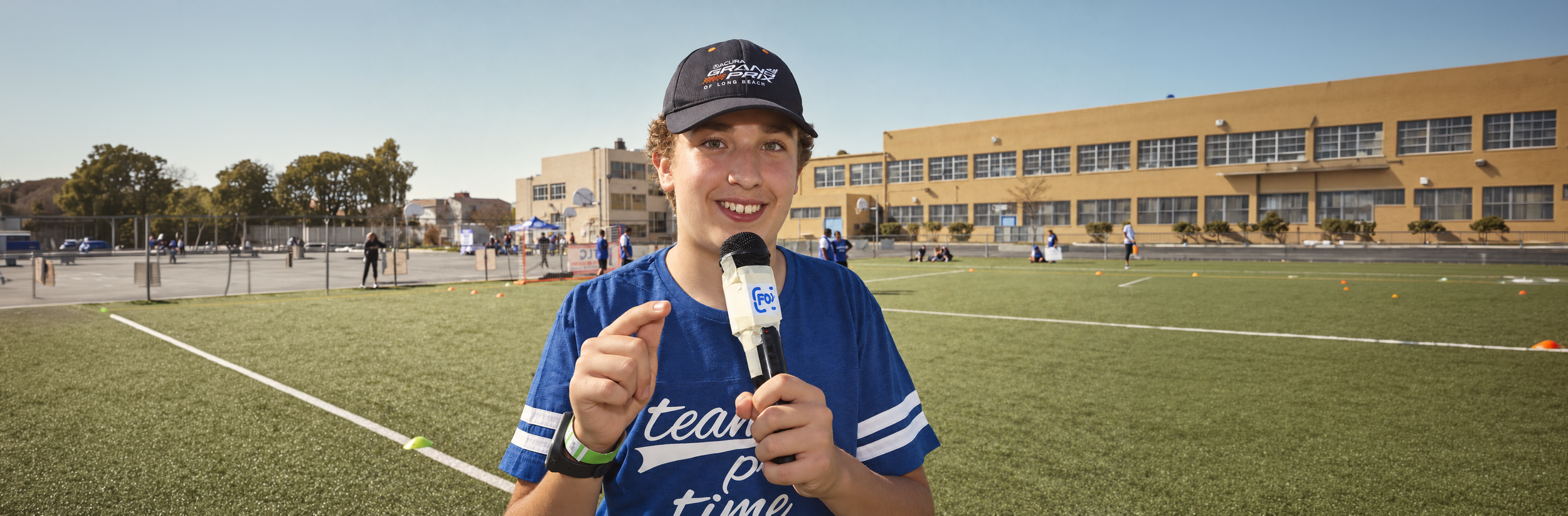
That is what Los Angeles nonprofit Team Prime Time is doing — with a twist. Its “varsity” basketball league pairs special-needs students — who have conditions such as Down syndrome, cerebral palsy or autism — with nondisabled peers, many of whom are low-income. The league, in its second season, includes Fairfax, Venice and two other schools.
“We are taking two marginalized populations and making them a part of the school fabric,” said Peter Straus, founder of Team Prime Time.
Bonding continues well after the final buzzer. Sarah Esther, an Orthodox Jew, and Baylee, an African-American, give each other high-fives in the halls; they often sit together in the cafeteria. Both have gained recognition from the broader school community. “The school is catching on to this, and it’s a game-changer for everyone,” said Judi Edwards, Fairfax’s athletic director.
The program is a partnership with Los Angeles Unified School District. The nation’s second-largest district after New York City’s, it has more than 650,000 students, about 80% of them eligible for reduced-price or free lunches.
Research has shown that economically disadvantaged students who participate in sports or other extracurriculars are more likely to complete high school and less likely to have behavioral problems.
For special-needs students, schools are increasingly seeking integration with regular students to boost self-esteem and improve learning.
Like other districts, Los Angeles Unified has many demands for limited funds. Team Prime Time taps local businesses to pay for uniforms, referees and staff for the blended teams, which cost about $10,000 per school. The goal is to expand the league to 16 schools in Los Angeles by 2015.
Mr. Straus’s dream is to have his model replicated nationally. Earlier this year, he traveled to Washington to introduce the program to several lawmakers. Rep. Henry Waxman (D., Calif.) said Team Prime Team “breaks down the barriers that too often separate special-needs youth from other students.” The program, he said, “offers a terrific model that school districts should consider.”
School districts in several states hold competitions for disabled athletes. In Maryland’s public schools, high-school students with disabilities join in sports such as bocce ball and bowling with nondisabled peers.
In the Los Angeles program, because students are paired, games are six-on-six instead of five-on-five, but only special-needs students shoot. Most of the special-needs players are new to basketball and had to learn not to grab opponents.
At the game in Fairfax’s main gym, Devante Scovell, a 6-foot-1-inch center for Venice who has autism, helped his team take control early on. Another powerhouse for the Mighty Gondoliers was Raul Velasco, a 5-foot-tall player with Down syndrome. Fairfax’s autistic 6-foot-3-inch Clinton “C Money” Moore was guarding Raul as the game heated up. Joseph Ragsdale, a Fairfax player with Asperger’s syndrome who also had reconstructive surgery on both legs, scored a basket.
No scuffles broke out. There were few fouls, many layups and plenty of timeouts. Each team had its ball hog. At one point, a nonverbal autistic player, excited after making a basket, strayed away from the action. His peer coach escorted him to the bench.
The “Gondos” led the Lions by two points as time wound down. But Fairfax’s No. 6, Tiger Reihel, tied the game and then scored on a buzzer beater, clinching a 32-30 Fairfax victory. “It’s a gift to play on the school team,” said C Money.
Rikky Wolin, there to videotape her kid sister, Sarah Esther, said: “We’d never seen her beaming like this before. She tells everyone she meets about her basketball league.”
Asked what she thought, the player gave a thumbs up and declared: “I am a winner.”
License this article from Dow Jones Reprint Service [http://www.djreprints.com/link/DJRFactiva.html?FACTIVA=wjco20130530000129] Dow Jones & Company, Inc.
By Miriam Jordan

Developing Inclusive High School Team Sports for Adolescents with Disabilities and Neurotypical Students in Underserved School Settings
The authors investigated the effects of a collaborative after-school inclusive sports program on adolescents with disabilities and neurotypical students in underserved high schools. The program brought together a large urban school district and a private after-school program to provide a service on the school site. The goals were to provide a truly integrated sports environment for adolescents with disabilities and to provide underrepresented minority students an opportunity to gain service learning, improved social–emotional development, and greater self-perceived impact. The project was feasible and indeed continued well beyond the evaluation period. Quantitative results indicated that the neurotypical adolescents felt they had an impact on improving the responsibility of their peer athlete, and they felt they had better perspective taking after participating. Descriptive comments indicated that the children with disabilities enjoyed participation and that this inclusive program may have provided an additional avenue for a subset of the population to engage more in the activities of their school. Program details are presented to encourage further research and replication.
Full article available upon request. Abstract obtained from: https://academic.oup.com/cs/article-abstract/45/2/88/7060046?redirectedFrom=fulltext
AfterSchoolAlliance.org
New program spotlights: How two afterschool programs are keeping students physically active through supportive relationships
By ALANA EDMOND Posted: Jun 23, 2025
A recently released brief, “Building Healthy Habits and Healthy Futures: How Afterschool Programs are Supporting Physical Activity and Healthy Eating,” explores the ways afterschool programs are instilling healthy habits in young people, one of which is through supportive relationships that encourage nutritious eating and excitement about physical activity. Two new program spotlights on Team Prime Time and Momentum Bike Clubsdelve into how supportive peer and mentor relationships encourage students to be physically active and help them grow their self-esteem.
With 24 locations throughout California’s Los Angeles and Inglewood Unified School Districts, Team Prime Time is an afterschool program offering a host of enrichment opportunities, including a leadership component centered around its full-inclusion sports program, Prime Time Games. Prime Time Games offers two underserved populations—low-income youth and students with disabilities—a one-of-a-kind opportunity to experience sports like basketball, soccer, and flag football, as a team. Through the program’s Peer:Pair model, peer coaches and athletes play as a unit on the field or court, allowing both groups to learn from each other and develop meaningful, lasting relationships with one another. As one athlete puts, "being a part of the team is like being a part of family. It makes me feel like I blend in well.”
In Greeneville and Pickens Counties, South Carolina, Momentum Bike Clubs is teaming 3rd-12th grade students with teachers from their schools to journey through bike trails within and outside of their communities, while fostering strong peer-to-peer and mentor relationships. Located throughout several schools and community sites, Momentum Bike Clubs is dedicated to helping underserved youth realize their full potential through the power of cycling and mentorship. Coupled with the confidence boost students gain from conquering long and challenging bike rides, the mentorship students receive from their teachers helps unlock greater self-esteem, resilience, and motivation, empowering students to push themselves physically and mentally and pursue new aspirations and goals beyond the program. The results of programming are outstanding: 95% of youth participants increased their weekly physical activity levels, 75% of participants showed significant improvements in self-esteem and confidence, and 95% of youth developed strong, positive relationships with their mentors.
Both Team Prime Time and Momentum Bike Clubs emphasize the value of integrating the program with the school day. Whether through bridging the social gap between students with and without disabilities attending the same schools, or through utilizing school-day teachers as mentors, both programs are intentional about growing students’ confidence and support systems through physical activity.
To learn more about what a typical day looks like in each program, their remarkable outcomes, and recommendations for the field, check out the full spotlights for Team Prime Time and Momentum Bike Clubs.
Original article: https://www.afterschoolalliance.org/afterschoolsnack/New-program-spotlights-How-two-afterschool-programs-are_06-24-2025.cfm